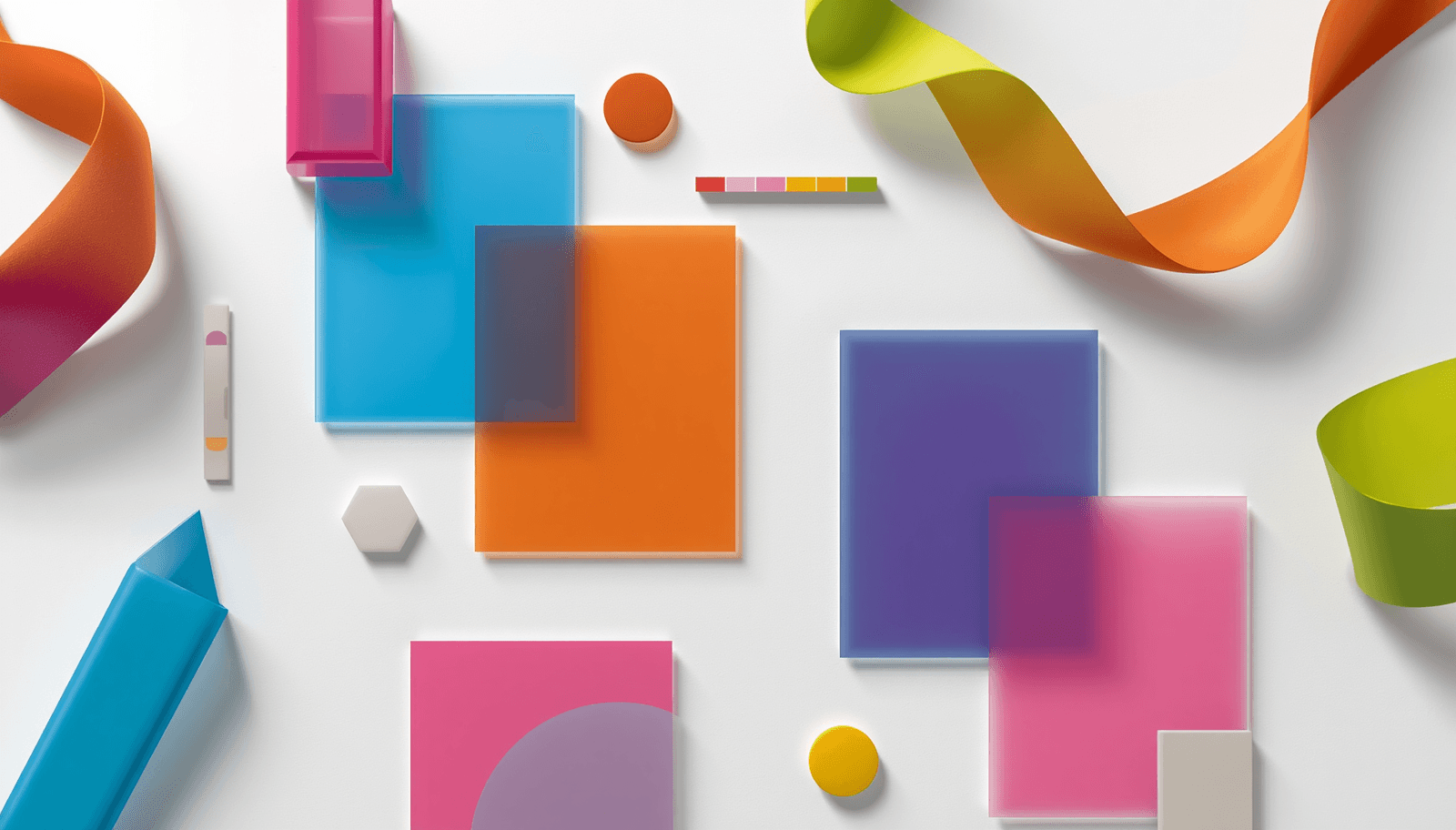
After several years dominated by muted neutrals and quiet, desaturated palettes, bold color is reasserting itself across design in 2026. Industry color forecasts describe this shift directly: after a long period defined by restraint, vibrant hues are returning with confidence — bringing optimism and personality back into visual design, with saturation reframed as expressive rather than overwhelming.
This shift is visible across interior design, fashion, and digital interfaces simultaneously. Interior designers report a return to bright, high-contrast pairings — turquoise with chartreuse, pink layered with blue — grounded by crisp whites to keep the overall effect feeling fresh rather than chaotic. In UI design, the trend has taken the form of "hyper-saturated accents" — single, intentional bursts of high-saturation color such as electric blue, neon green, or radiant violet placed within otherwise minimal, restrained layouts.
This guide covers the vibrant color combinations working across these contexts in 2026, with hex codes, the color theory mechanics behind each, and guidance on using high-saturation color without overwhelming a design. Generate and test any combination at ThemePalette.
The Color Theory of Vibrancy
Vibrant color combinations rely on a different set of structural principles than the soft, muted palettes covered elsewhere on this site. Understanding these principles is what separates a vibrant palette that feels "energetic and intentional" from one that feels chaotic.
Complementary pairs at full saturation. Colors positioned directly opposite each other on the color wheel — red and green, blue and orange, yellow and purple — produce the highest possible contrast and the most vibrant visual effect when both are used at high saturation. This is the foundation of most genuinely bold palettes.
Triadic schemes for balanced energy. Three colors evenly spaced around the color wheel create a vibrant and dynamic effect while offering more balance than a two-color complementary pairing. Triadic schemes are frequently used when a design needs to feel lively and colorful without becoming visually exhausting.
The role of neutral grounding. Even the boldest vibrant palettes typically rely on a neutral — usually white, black, or a near-neutral grey — to provide visual rest. Without this grounding element, multiple high-saturation colors compete for attention and the composition loses hierarchy. The interior design pairing of "turquoise with chartreuse, grounded by crisp whites" demonstrates this directly: the white is not decorative, it is structural.
One dominant, others supporting. A genuinely effective vibrant palette establishes a hierarchy — one color dominates the composition while others appear as accents. Tetradic (four-color, two-complementary-pair) schemes specifically work best with one dominant color managing what would otherwise be an overwhelming amount of contrast.
Vibrant Color Combinations for 2026
1. Turquoise and Chartreuse
Turquoise: #1FB6C1
Chartreuse: #C8E635
Crisp White: #FFFFFF
Charcoal: #2A2A2A
This pairing has been specifically identified by interior designers as a defining return-to-color combination for 2026 — a high-contrast cool-warm pairing grounded by crisp white to keep the overall effect feeling optimistic rather than aggressive. Turquoise and chartreuse sit roughly in a complementary-adjacent relationship, producing strong visual energy. The crisp white is essential — without it, this combination becomes difficult to look at for extended periods. Charcoal, used sparingly for text, provides the dark anchor that pure black would make too severe.
Best for: Lifestyle brands, youth-oriented products, event branding, packaging
2. Electric Blue and Neon Green
Electric Blue: #2D5BFF
Neon Green: #39FF14
Deep Charcoal: #1A1A1A
Light Grey: #E8E8E8
This combination exemplifies the "hyper-saturated accent" approach defined in 2026 UI design trends — using one or two extremely high-saturation colors as intentional focal points within an otherwise restrained, neutral-dominated layout.
In practice, this means electric blue and neon green should almost never occupy equal proportions of a design. One should dominate as the primary accent (buttons, active states) while the other appears more sparingly (notifications, highlights, data visualization).
Best for: SaaS dashboards, fintech apps, gaming interfaces, data visualization
3. Cyber Lime and Ultraviolet
Cyber Lime: #D4FF3D
Ultraviolet: #6B1FB8
Deep Black: #0A0A0A
Pure White: #FFFFFF
The combination of acidic yellow-green with deep violet-purple is part of a broader 2026 movement toward maximum-intensity hues — including electric blue, neon coral, pure magenta, cyber lime, ultraviolet purple, and sunrise yellow — used in vibrant gradients and high-contrast combinations that reflect digital fluency and a deliberate rejection of aesthetic restraint.
This pairing produces a strong "vibration" effect — the visual phenomenon that occurs when two highly saturated colors of similar lightness sit directly adjacent to each other. This effect can be used deliberately for poster art, motion graphics, and music or event branding where visual intensity is the goal, but should be avoided for body text or any extended-reading context.
Best for: Music and entertainment branding, motion graphics, festival and event design, streetwear
4. Pink and Cobalt Blue
Hot Pink: #FF1F8C
Cobalt Blue: #0047CC
Pale Yellow: #FFF4C0
Off White: #FAFAF8
Pink layered with blue is another combination specifically called out in 2026 interior color forecasting as part of the return to bright, high-contrast, optimistic palettes. As a complementary-adjacent pairing, pink and cobalt produce strong contrast while retaining a slightly more approachable quality than pure red-green complementary pairs, because both colors carry some blue undertone that creates a subtle connecting thread.
Adding pale yellow as a third color introduces a triadic-leaning structure that adds warmth and prevents the cool-pink-and-blue combination from feeling cold.
Best for: Beauty and cosmetics, youth fashion, creative agency branding, children's products
5. Neon Jungle: Lime Green and Violet
Lime Green: #B8E600
Violet: #8B2FD4
Deep Plum: #2A0E40
Cream: #FFF8E8
Lime green and violet form a high-contrast combination frequently described as having a playful, energetic character when the lime green dominates. As a near-complementary pairing (yellow-green against blue-violet), this combination produces strong visual impact while the cream and deep plum provide a tonal range that allows the bright greens and purples to read as intentional rather than purely chaotic.
Best for: Music streaming and entertainment apps, gaming, youth-targeted campaigns
6. Coral, Yellow, and Teal (Triadic Bold)
Bright Coral: #FF6B5B
Sunrise Yellow: #FFD500
Deep Teal: #007A7A
Warm White: #FFFBF5
This is a genuinely triadic scheme — three colors spaced at roughly equal intervals around the color wheel — producing the balanced vibrancy that triadic combinations are known for: lively and colorful without the harshness of a direct complementary pair. The warm white grounding keeps the combination feeling fresh rather than carnival-like, while still allowing all three colors to read at full intensity.
Best for: Food and beverage branding, summer campaigns, children's education, fitness apps
7. Magenta and Cyan (Classic High Contrast)
Pure Magenta: #E6007E
Cyan: #00C4E6
Near Black: #161616
White: #FFFFFF
Magenta and cyan represent one of the highest-contrast color relationships available in digital color — both are near-complementary, both can be pushed to maximum saturation, and both read clearly against both black and white backgrounds.
Best for: Tech and AI branding, digital art, futuristic product design, gaming
How to Use Vibrant Palettes Without Overwhelming a Design
Apply the 60-30-10 proportion rule, strictly. For vibrant palettes more than for any other category, proportion determines whether a design feels bold and intentional or simply loud. The dominant neutral or near-neutral should occupy roughly 60% of the visual space; the primary vibrant color roughly 30%; the secondary accent color roughly 10%.
Use vibrant color for a single purpose at a time. A button, a data point, a single graphic element. When multiple vibrant colors compete for the same role — multiple call-to-action buttons in different bright colors, for instance — none of them function as a focal point because there is no hierarchy.
Test against both light and dark contexts. Many products now need to support both light and dark mode, and vibrant colors behave very differently against each. A neon green that pops against white can become harsh and difficult to look at against black. Test vibrant accent colors in both contexts before finalizing.
Verify text contrast specifically. High-saturation colors at mid-lightness frequently fail WCAG contrast requirements when used as text against white or black. The Web Content Accessibility Guidelines (WCAG) 2.1 require a minimum 4.5:1 contrast ratio for normal body text — many vibrant colors in this guide are appropriate for accents, buttons, and graphics, but not for body text itself. Use ThemePalette's contrast checker to verify any vibrant color intended for text use.
Conclusion
Vibrant color combinations in 2026 represent a genuine shift from the muted, restrained palettes that dominated recent years — but the most effective applications of this trend are disciplined rather than indiscriminate. High-saturation color works best when it has a clear job: a single accent, a focal point, a deliberate moment of visual energy within an otherwise calm composition.
The combinations in this guide — from turquoise and chartreuse to magenta and cyan — can be generated, adjusted, and exported for free at ThemePalette.com.